Secondary General Music Lesson Ideas




A Little History
The medieval period lasted from approximately 500-1450 A.D. and was a time of heavy church influence. Music was obviously around before this time and had various developments, but during the Medieval Period much of the creation and use of music was regulated by the church. Religious music, called Gregorian chant, was sung or chanted by monks, performed without instrument accompaniment, and had monophonic texture. Take a listen...
Around the year 900, some simple harmony of two vocal parts was allowed. This was possibly because singing one part all of the time is boring, or because some monks could not sing in tune. Regardless of how it happened, this type of simple two-part medieval harmony is called organum and was made in one of two ways: with a drone, or the words of the song would be sung on two different pitches at the same time.
While a lot of the music during the Medieval Period was composed for the church, non-religious music was also created during this time. Most non-religious music was made up of folk songs and ballads, many of which were sung/played by wandering musicians called troubadours.
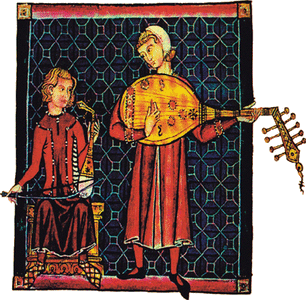
Troubadours sang mostly about love or great valor in battle, and they accompanied themselves with all kinds of instuments. The lute was a popular instrument used by Medieval musicians, as were percussion instruments, such as drums, cymbals, and bells. There were also some wind instruments, of which many were quite 'interesting' in both look and sound. These instruments include the Hurdy-Gurdy, Zither, Recorder, Shawm, Cornamuse, Bladderpipe, Doleimer, Zink, and the Serpent.
Hurdy-Gurdy Serpent Lute
Zink Cornamuse Shawm
The Renaissance Period, 1450-1600 A.D., takes its name from 'rebirth', and was a time for growth in music and art. The invention of the mechanical printing press was one of the main reasons for this growth. Instead of handwritten music scores, which often contained errors and variants, musicians could now buy scores that were slightly cheaper and with a uniform accuracy. This gave people a plentiful supply of new music.
Musically, many changes started taking place during the Renaissance. Music of the Medieval Period tended to be primarily unison songs for voice where instruments were just used for accompaniment. During the Renaissance period, composers starting writing music specifically for instrumentalists (of course they usually did not state which instrument was to play the music). Additionally, vocal music became more polyphonic.
Music notation also developed during the Renaissance Period. Previously in the Medieval Period, Neumes (square-looking notes) were used to notate Gregorian Chant. This type of notation showed only the up or down direction of the melody and some of the ornamentation, which meant a musician really had to know the piece before the notation made any sense. Musicians in the Renaissainc Period began adding flags and different kinds of note heads to show how long the note should be held out as well as its pitch. This meant that persons not familiar with the piece of music could still play/sing it and have it sound as it was originally intended. Take a look at the manuscripts from the Medieval and the Renaissance Periods to see differences.
Renaissance religious music was an extension of the Gregorian Chant from the Medieval period, and was performed without instrument accompaniment. The texts were also the same as in Gregorian Chant with the Roman liturgy sung in Latin. Renaissance non-religious music, however, really developed during this time. For example, in 16th-century Italy the madrigal became an especially popular musical form for aristocratic audiences. A madrigal is music set to a one-stanza secular poem, typically about love and crowded with poetic images and highly conceptual, often oblique metaphors that are called 'conceits'.
Renaissance composers reasoned that if a poet could express emotions through words, then music could do so by illustrating the meaning of the words being sung. This thinking led to the creation of the most characteristic expressive devices of the madrigal: declamation and word painting. Declamation involves setting the words of a text so the rhythms of normal speech are reflected in the music. With word painting, a composer sets a word, phrase, poetic image, or conceit to music that directly illustrates the textual meaning. For example, the word 'running' would be set to rapid rhythms, whereas 'up' would be set to notes that are higher in pitch. Let's listen and watch this video of Fair Phyllis by John Farmer. Notice the use of polyphonic texture as well as how the composer musically depicts the words 'up and down'.
Like dancing today, dance in the Renaissance period was often done for entertainment. However, it was also considered a social expectation. Royal court stewards were constantly dancing to prove their worth. In fact, to be taken seriously as a cultivated person, you were expected to have great dance skills. Dancing was often done in pairs, and as such, it was a natural component of courtship. Of course, this meant it was important to dance properly if one did not want to be single forever!
At the beginning of the Renaissance, dance music was primarily instrumental arrangements of popular vocal works. As the period progressed, dance and dance music grew increasingly more intricate. Instrumental music started being written exclusively for dances, using specific rhythms to guide the dancers' steps for increasingly complex dance choreography. While viewed at the time as a social entity, the dances of the Renaissance period highly influenced music of later periods, such as ballet and other forms of dance.
Many famous people were alive during the Medieval and Renaissance Periods. Let's take a trip in the Time Machine to see some of those we might know (click icon below to access the keynote presentation).
Below is a brief overview of the Medieval and Renaissance Periods by Classic FM.
Finally, there are several great videos of performaces using period instruments...definitely interesting to watch and listen. BTW - The term Consort was used during the Renaissance Period to denote an instrumental ensemble.






Counter Tenor & Consort Recorder Consort
Rackett Consort Crumhorn Consort
Viola da Gamba Consort Lute Consort


Palestrina
Tallis
Below are two mini history lesson for the composers Tallis and Palestrina, a short lesson about motets and madrigals, a Renaissance soprano recorder activity, as well as two cross-curricular extention activities. To access, click on the specific 'portrait' or button below.

