Secondary General Music Lesson Ideas
Birth
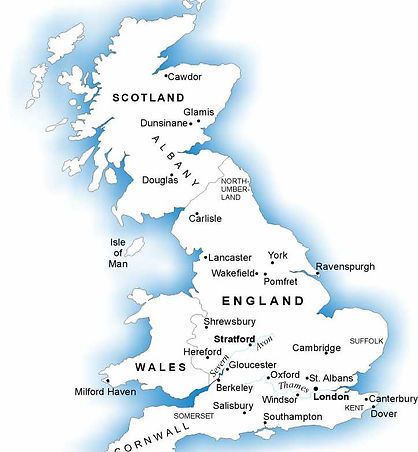
Thomas Tallis was born around 1505 somewhere in England (possibly Kent). Little is known about Tallis' early life, including where he was born and his parents' names. There are suggestions that as a child he sang with the Chapel Royal St. James' Palace, the same singing establishment which he later joined as a man.
During His Lifetime
Tallis' first known musical appointment was as an organist in a Benedictine priory in Kent around 1532. From there he worked in several churches before he was sent to Court as Gentleman of the Chapel Royal in 1543. While in this post he composed music for all of the Tudor Kings and Queens with the exception of King Henry VII: Henry VIII (1543-1547), Edward VI (1547-1553), Queen Mary (1553-1558), and Queen Elizabeth I (1558 until Tallis died in 1585). This was probably a very difficult task since each monarch had very different ideas of what church music should sound like.
For the last ten years of his life, he and one other English composer, William Byrd (c.1540–1623), were the only people allowed to print music in England, which made both very wealthy. Interesting fact: The picture of Tallis on this page is the only one there is of the composer and it was painted about 150 years after he died. This means, of course, that it is very unlikely this picture looks anything like Tallis at all.
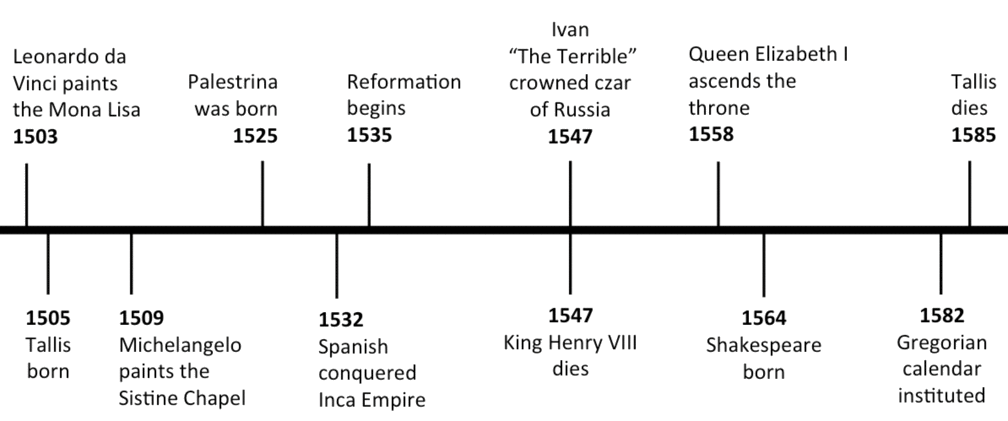
Several things happened during Tallis' lifetime that you might have heard about before today.
Death
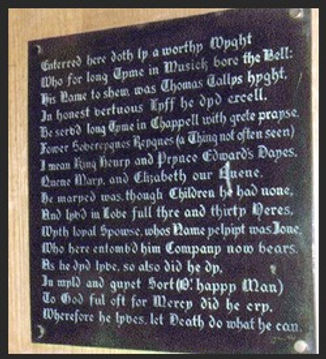
Thomas Tallis died peacefully in his house in Greenwich in 1585. He was buried in the chancel of the parish of St Alfege Church in Greenwich. To this day, the exact location of his remains is unknown. It is believed his remains may have been discarded by laborers between 1712 and 1714 when the church was rebuilt. While nothing remains of Tallis's original memorial in the church, it is claimed that a brass plate with an engraving describing him was 'found' (see picture). This engraving reads:
Entered here doth ly a worthy wyght,
Who for long tyme in musick bore the bell:
His name to shew, was THOMAS TALLYS hyght,
In honest virtuous lyff he dyd excell.
He serv’d long tyme in chappel with grete prayse
Fower sovereygnes reygnes (a thing not often seen);
I meane Kyng Henry and Prynce Edward’s dayes,
Quene Mary, and Elizabeth oure Quene.
He mary’d was, though children he had none,
And lyv’d in love full thre and thirty yeres
Wyth loyal spowse, whose name yclypt was JONE,
Who here entomb’d him company now beares.
As he dyd lyve, so also did he dy,
In myld and quyet sort (O happy man!)
To God ful oft for mercy did he cry,
Wherefore he lyves, let deth do what he can.
~~~~~~~~~~~~~~~~~~~~~~~~~~~~~~~~~~~~~~~~~~~~~~~~~~~~~~~~~~~~~~~~~~~~~~~~~~
Type of Music
Tallis was a composer during the Renaissance Period. He was employed as a church musician for most of his adult life, which meant most of his compositions were written for the church. Futhermore, almost all of his music is for singing without instruments. Below is a YouTube video that describes Tallis' life and music in more detail.
Most Famous Music
Tallis' most famous piece of music is his Spem in alium, a motet written for 40 different voice parts. This means that at least 40 voices are needed to sing it! This piece is considered to be a motet, which is a polyphonic choral composition.
~~~~~~~~~~~~~~~~~~~~~~~~~~~~~~~~~~~~~~~~~~~~~~~~~~~~~~~~~~~~~~~~~~~~~~~~~~
Listening
The videos below are great examples of Tallis' most famous music, Spem in alium. The first video is of the motet with minimal pictures. The second video is of the King singers (of which there six members) recording all the parts to this 40 voice motet. To do this the six singers chose one part each and then recorded themselves singing it through. Then they chose another part and sang that through while listening to what they had already recorded. They did this again… and again…and again until all voice parts had been sung - amazing! The final video is of an animated graph that illustrates the 40 different voice parts.
Renaissance Period
~ Tallis