Secondary General Music Lesson Ideas
Form
~ Sonata

Lesson Plan
1. So far we have talked about Binary (A B ), Ternary (A B A), Theme and Variation (A A' A'' A''' A'''') and Rondo (A B A C A) Form. Today we will be talking
about a slightly more complex Form, Sonata Form.
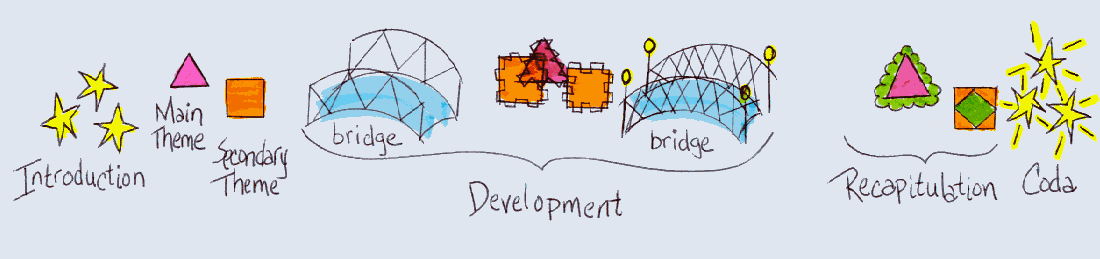
Definition: Sonata Form is a three-part Form (A B A) made up of an Exposition, Development, and Recapitulation.
The Sonata Form is like a complex version of Ternary Form; however, instead calling the Sections A B A, Sonata Form has specific names and purposes
for each Section.
2. The first thing you may hear in Sonata Form is an introduction. I say 'may' because this is optional and some composer do not include it. If it is included,
it is often in a slower tempo then then next section (Exposition). Let's listen to the introduction of Beethoven's Piano Sonata No. 8, movement 1.
3. Next, you will hear the first main Section, which is called the Exposition.
Definition: The exposition is the first main section of Sonata Form in which the composer presents two melodic themes.
These themes are important because they set the musical 'topic' for the rest of the piece. The themes are always the same tonality, either major or minor.
Let's listen to the Exposition in Beethoven's Piano Sonata No. 8.
4. The second main Section of Sonata Form is called the Development. In this section a composer will take the two melodic themes from the exposition and,
well, develop them. Sometimes this means that composers will present the themes from the exposition in different keys, while other composers will also
add a new theme or two. Let's take a listen to the Development in Beethoven's Piano Sonata No. 8.
Definition: The Development is the second main section of Sonata Form, and it is where the composer takes the themes from the exposition and
presents them in different keys. This section may also include new themes.
5. The third and final main Section of Sonata Form is called the Recapitulation. Basically, this is just a fancy term for repeating the themes found in the
exposition with a few twists (kind of like A and A'). Let's take a listen to the Recapitulation in Beethoven's Piano Sonata No. 8.
Definition: The Recapitulation is an altered repeat of the exposition.
6. The final, final thing you may hear is the Coda. Again, I say 'may' because this is optional (just like the introduction). In Beethoven's Piano Sonata No. 8,
the is no Coda.
7. To get a full appreciation for Sonata Form, you should listen to the movement in its entirety.