Secondary General Music Lesson Ideas
Form
~ Symphony

Note: This lesson was created by Megan McMahon in 2015. The Classroom Notes Worksheet that accompanies the lesson can be found here (click).
Lesson Plan
1. In our last lessons about Form we have talked about Concerto, a work for soloist and orchestra. Along with that, we talked about Concerto form, which
has three movements: fast, slow, and fast.
2. Today, we will be talking about a new musical form: Symphony form.
Definition: Symphonies typically have four movements: fast, slow, dance, and fast.
A symphony is an elaborate musical composition for full orchestra. Furthermore, at least one of these movements is in Sonata Form, which we will talk
about in-depth in a previous lesson.
The symphony came to popularity in the eighteenth century. Composers like Franz Joseph Haydn and Wolfgang Amadeus Mozart took the concept and
brought it to light, allowing the symphony to become a staple of the 18th century. In fact, they both liked the symphony so much, that Haydn wrote 106 of
them, and Mozart wrote 41.
3. Each of the four movements of a symphony has distinctive characteristics that became common practice throughout the 18th century. The first movement
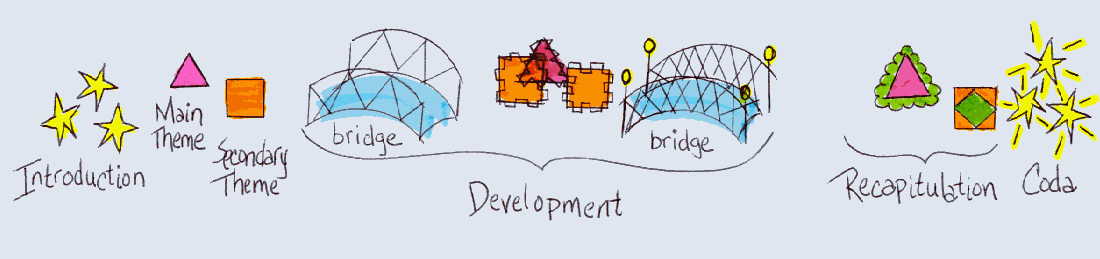
is typically in Sonata Form, or “First movement form”. This movement will have two main themes that are introduced and then altered, or developed,
through the movement. It looks something like this:
Sometimes the movement will open with an introduction before the first main theme is heard. Here’s what the introduction to Beethoven’s third symphony
sounds like…
4. The second movement is usually a slow movement. Common tempo markings include Andante, Adagio, and Lento. There isn’t a list of forms associated
with the slow movement. Many composers pick whatever form they want and set it to a slow tempo. It can be in minor and very funeral-like, but it can
also be cheerful or wistful. Here’s the second movement of the same Beethoven symphony, titled “funeral march”.
5. The third movement's tempo is fast and is often in a “dance” form. It will probably sound like you could waltz to it! It can be a minuet and trio, which
is in 3/4 meter, or a scherzo, meaning joke, which sounds more like a frantic dance in 6/8 meter. This movement almost always has a middle, contrasting
section to the beginning and ending, which make this movement ternary form (ABA). Here’s what the Scherzo from Beethoven’s third sounds like.
The second and third movements of a symphony can be switched, having the dance first, and then the slow movement.
6. The fourth movement is the finale of the work. It feels like it’s moving forward, toward the end of the work. It can have the tempo markings Allegro molto or
Presto. This movement can also be in Sonata Form, which we remember looks like this:
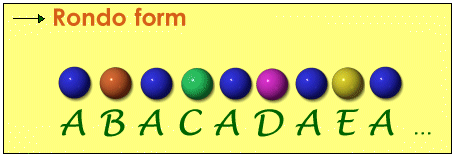
but it can also be in Rondo form, which looks like this:
Rondo form is a form in which a theme is brought back several times in the movement. The cool thing about Rondo form is that the composer can make
as many new themes as he wants. He can stop after ABACA or he can be obnoxious and make the movement ABACADAEAFA, etc.
Here’s a snippet of the last movement of Beethoven’s third symphony.
7. So how do we figure out which movement is which? There are a couple of ways we can distinguish the movements from each other. All movements are
labeled with at least their tempo markings. Some composers will be a little more specific. Take, for example, Beethoven’s third symphony. Beethoven
labels three of the four movements with specific indicators along with their tempo markings.
8. Let’s make some new symphonies, shall we? Get into groups of 3-4 and, using the Classroom Notes Worksheet and the things we’ve talked about today,
I want you to make your own symphonies. The first movement has to be Sonata-Allegro form, but you can decide if you want an introduction. Then make
the next three movements using the parameters discussed. You can even give the movements names if you want. Take a few minutes and when you’ve
made your symphony, go ahead and write them up on the board!