Secondary General Music Lesson Ideas
Synopsis
The story of Rodeo centers around a Cowgirl who was raised at Burnt Ranch, and who strives to step out of her 'just one of the guys' persona. She seeks the attention of the Head Wrangler. Unfortunately, the Head Wrangler, like the rest of the cowboys, is rather taken with the more feminine Rancher's Daughter.
The Cowgirl attempts to gain the attention of the Head Wrangle by mimicing the surrounding cowboys. This is unsuccesful. Despondent, the Cowgirl runs through the empty corrals until the Head Wrangler discovers her in the darkness. She, however, is too sad and depressed to talk to him when he askes what is wrong. Confused, the Head Wrangler exits with the Rancher's Daughter.
Later, at a ranch party, the Cowgirl watches as the Champion Roper and the Head Wrangler try to gain the attention the Rancher's Daughter. The rest of the cowboys also pair off with the other girls at the party, and the Cowgirl finds herself quite alone... that is until the Champion Roper approaches her (after having failed to best the Wrangler in winning the affections of the Rancher's Daughter).
The ranch is hosting a Hoe Down and all the cowboys, as well as other locals, will be there. In a tale as old as time, the Cowgirl puts on a beautiful dress for the Hoe-Down in the hopes of finally attracting the attention of the Head Wrangler. She does. However, once she has his attention, she realizes the right guy for her is not the aloof and snooty Head Wrangler at all, but another cowboy who has shown her respect, kindness, and honor. The final scene of the ballet is of the Cowgirl and the Roper sharing a kiss in a stand-up-and-cheer Hollywood Western ending!
Activity 1 - Listening
The music for Rodeo ballet was written by Aaron Copland, who was a composer during the Modern Period. Copland grew up in Brooklyn, many miles from the western frontier; however, he is credited with creating an 'American West' sound. This is because he used music that everyone would recognize as 'American' music, such as folk songs, cowboy ballads, and fiddle tunes, in his compositions. He also used intervals of fourths and fifths, like the tunings of a violin. Using these new ideas, his compositions seem to represent the open prairie and western frontier, which greatly appeals to the general public.
Copland used several folk songs, cowboy ballads, and fiddle tunes in the music for Rodeo. We are going to listen to the original melodies, then we will watch a scene from the ballet. Your task is to raise your hand when you hear the original melody in the ballet.
The first excerpt we will be listening to is called 'If He'd Be A Buckaroo' performed by Peggy Seeger. Your task is to remember the melody so you can recognize it later in the ballet.
Now let's watch a scene from Rodeo where the cowboys are trying to impress the Rancher's Daughter and her friends. Your task is to raise your hand each time you hear the melody 'If He'd Be A Buckaroo' - yes, the melody will happen more than once.
The second excerpt we will be listening to is called 'Bonaparte's Retreat' performed by William H. Stepp. Again, please remember the melody so you can recognize it later in the ballet.
Now let's watch a scene from Rodeo where the Hoe Down is just starting. Please raise your hand when you hear the melody 'Bonaparte's Retreat'.
Activity 2 - Listening
The following video is a listening map of Hoe Down by Erica Cooter. Questions that could be asked include:
-
What are the different instruments that play during the music.
-
What instruments are normally used in an orchestra and which instruments are slightly unusual to use in an orchestra?
-
Do you hear the violin 'tuning'? Raise your hand every time you hear the violins do this?
Activity 3 - Square Dancing
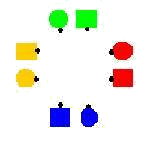
We are going to learn basic square dancing. A square consists of four couples, with one couple stationed on each of the four sides of the square. Each member of a couple is the other member's partner. Traditionally, a couple consists of a 'boy/man' and a 'girl/lady', with the 'boy' standing on the left. HOWEVER, for today's square dance, you can partner up with whomever you would like. The person on the left of each couple is #1, and the person on the right of each couple is #2. Everyone starts facing the center of the square.
A caller at a square dance is responsible for calling out the instructions to the dancers. Today the caller (Dr. VW) will call the following steps. These are:
-
BOW
Dance Action: Dancers bow to their partners or bow to their corners. May also use a curtsy.
-
CIRCLE
Dance Action: Dancers join hands with adjacent dancers to form a circle and move the circle in the direction indicated by the caller (either left or right).
-
FORWARD & BACK
Dance Action: Dancers join hands with those next to them, walk forward 3 steps into th circle, pause, walk backwards 3 steps back out of the circle, and pause.
-
DO SA DO
Dance Action: This is like walking around your partner in a circle. Dancers start facing each other but slightly off to the side, then walk forward (passing right shoulders), walk sideways to the right, walk backwards (passing left shoulders), and walk slightly to the left to return to their starting position. Should be done in 4 beats.
-
PROMENADE
Dance Action: Dancers face in the indicated direction (either left or right), join arms at the elbow with their partner, then walk around the circle.
Practice each step without music, then add music (I often use Bonaparte's Retreat to create a tie-in with the lesson, but there are lots of great square dance tunes out there).
As a wrap-up for the square dance activity I usually ask the students to watch a clip from 'Hillbilly Hare' and see if they can identify any of the square dance steps we learned.
Rodeo
~ Ballet