Secondary General Music Lesson Ideas

The
Star-Spangled Banner
A Little History
On a rainy September 13, 1814, British warships sent a downpour of shells and rockets onto Fort McHenry in Baltimore Harbor, relentlessly pounding the American fort for 25 hours. The bombardment, known as the Battle of Baltimore, came only weeks after the British had attacked Washington, D.C., burning the Capitol, the Treasury and the President's house. It was another chapter in the ongoing War of 1812.
A week earlier, Francis Scott Key, a 35-year-old American lawyer, had boarded the flagship of the British fleet on the Chesapeake Bay in hopes of persuading the British to release a friend who had recently been arrested. Key's tactics were successful, but because he and his companions had gained knowledge of the impending attack on Baltimore, the British did not let them go. They allowed the Americans to return to their own vessel but continued guarding them. Under their scrutiny, Key watched on September 13 as the barrage of Fort McHenry began eight miles away.
"It seemed as though mother earth had opened and was vomiting shot and shell in a sheet of fire and brimstone," Key wrote later. But when darkness arrived, Key saw only red erupting in the night sky. Given the scale of the attack, he was certain the British would win. The hours passed slowly, but in the clearing smoke of "the dawn's early light" on September 14, he saw the American flag—not the British Union Jack—flying over the fort, announcing an American victory.
Key put his thoughts on paper while still on board the ship, setting his words to the tune of a popular English song. His brother-in-law, commander of a militia at Fort McHenry, read Key's work and had it distributed under the name "Defence of Fort M'Henry." The Baltimore Patriot newspaper soon printed it, and within weeks, Key's poem, now called "The Star-Spangled Banner," appeared in print across the country, immortalizing his words.
But Key had not written the American national anthem. In fact, for more than a century after that day, America had no national anthem at all. For decades The Star-Spangled Banner was played by military bands as just another patriotic song, and by the early 20th century, there were various versions of the song in popular use. It was not until after World War I that a concerted effort to use The Star-Spangled Banner as the national anthem gained speed. Seeking a singular standard version, President Woodrow Wilson asked the U.S. Bureau of Education to provide an official version. In response, the Bureau enlisted the help of five musicians to agree upon an arrangement. The standardized version that was agreed upon by these five musicians premiered at Carnegie Hall on December 5, 1917.
In 1925, TIME magazine reprinted an anti-“Banner” letter from a man who found it “hurtful to every ideal which Americans cherish” in its violence (particularly toward Britain, an ally) and who said that he would refuse to remove his hat while the song was played. Another group was represented by people like John C. Wright, who also wrote a letter, who declared the octave-and-a-half range was just too hard to sing. That was why, in Feb. 1930, the pro-“Banner” group invited the U.S. Navy Band and two professional sopranos to perform The Star-Spangled Banner for the House Judiciary Committee (to prove that its words were not difficult, and that its pitch was not too high). While it not known whether this ploy actually was the deciding factor, nonetheless it worked. On March 3, 1931, President Hoover signed the bill into law, and the U.S. had a national anthem for the first time.
Why Is The Star-Spangled Banner So Hard To Sing?
While The Star-Spangled Banner resonates with people in different ways, for different reasons, history has shown that, despite its other virtues, the song is not exactly easy to sing. When compared to other 'popular' songs, The Star-Spangled Banner does not have a memorable chorus or hook. It also is not written in what could be called colloquial speech (so it is a bit awkward to speak the lyrics and to memorize it).
The lyrics also appear as if it is an AABA structure (Ternary Form). The first A section (lines 1 and 2) parallels the second A section (lines 3 and 4). The B section (lines 5 and 6) is a different section entirely. The last A section (lines 7 and 8), looks similar to the first and second A sections, but is set to totally different music, which makes it sound as if it is an entirely new section (section C). All of this makes the structure of The Star-Spangled Banner read like an AABA form, but it sounds like an AABC form.
We also do not really hear the rhymes as much as we normally would if it was a popular song that has a repeated rhyme scheme from verse to verse. This is because The Star-Spangled Banner has an irregular rhyme scheme - AB AB CC DD - so the rhymes do not lead the ear in the way we would expect. Finally, the melody of The Star-Spangled Banner is an octave and a half - which means the notes go quite low and quite high. While this might be fine for a professional singer, it can prove very difficult for the average person.
All of these issues lead to one thing... The Star-Spangled Banner is hard to sing.
Is Correct Etiquette A Matter of the Law?
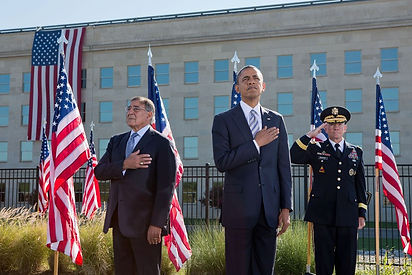
Federal code states that during a rendition of the national anthem when the flag is displayed, all present except those in uniform should stand at attention facing the flag with the right hand over the heart. Members of the Armed Forces and veterans who are present and not in uniform may render the military salute; men not in uniform should remove their headdress with their right hand and hold the headdress at the left shoulder, the hand being over the heart; and individuals in uniform should give the military salute at the first note of the anthem and maintain that position until the last note. When the flag is not displayed, all present should face toward the music and act in the same manner they would if the flag were displayed. This code, however, does not have any penalty associated with violations, and the behavioral requirement for the national anthem is subject to the same First Amendment controversies that surround the Pledge of Allegiance.
What's Up With All The Different Versions?
Even though a standard version of The Star-Spangled Banner was agreed upon in 1917, our national anthem continues to be a song in which American artists put their individual stamp. Some of these attempts have become famous while others have become infamous. We will only be discussing the 'good' versions during this lesson, but if you would like to see the 'not good' versions, just go to YouTube and you will find pages of them.
The first version we will talk about was arranged by Igor Stravinsky, a naturalized citizen from Russia. His version led to an incident on January 15, 1944 with the Boston police. After Stravinsky conducted it with the Boston Symphony, the police informed the composer of a Massachusetts law against tampering with national property, and removed the parts from Symphony Hall. The police, as it turned out, were wrong. The law in question merely forbade using the national anthem "as dance music, as an exit march, or as a part of a medley of any kind", but the incident soon established itself as a myth, in which Stravinsky was supposedly arrested, held in custody for several nights, and photographed for police records. A widely known photograph of Stravinsky, supposedly his mugshot, was 'actually' for a passport application (I still think it looks like a mugshot). While Stravinsky's version may have been controversial for the time, today it sounds pretty tame.
The second version we will listen to was arranged by John Williams for the 200th anniversary of the national anthem in 2014. Williams, who is a famous movie composer (think Jaws, Star Wars, Harry Potter...) created an arrangement that is big, bold and, yes, cinematic. It features a patriotic combination of talent including the Joint Armed Forces Chorus, the Choral Arts Society of Washington, the U.S. Army Herald Trumpets, the National Symphony Orchestra, and cannons.
Jimi Hendrix created several versions of The Star-Spangled Banner, but it is his version that was played at Woodstock in 1969 that is most remembered. The Woodstock Music and Art Fair, a celebration of peace and music, was staged amid the tumult in the United States created by the Vietnam War. Hendrix, who was a major star at the time, closed the festival. After playing many of his hit songs, Hendrix launched into his own interpretation of The Star-Spangled Banner. As one concert-goer stated: "When he played ‘The Star-Spangled Banner,’ it was shocking to everybody”. The jarring, uplifting, haunting, energizing anthem was done at times in straight single notes, while at other times was spiced with trademark Hendrix innovations, especially the use of amplifier feedback, sometimes to convey the sounds of war — bombs falling, jets overhead — as well as lip synched human cries and screams and the playing of 'Taps'. The sheer emotional impact of Jimi Hendrix’s Woodstock rendition makes the abstract of war so very human.
The last version we will listen to was performed by Whitney Houston in 1991. When Houston was announced as the performer of The Star-Spangled Banner at Super Bowl XXV, her longtime musical director suggested taking the song out of standard 3/4 meter and adding an extra beat per measure, which put it into 4/4 meter. Two weeks before the Super Bowl Houston heard the arrangement, and about ten days later she recorded a breathtaking game-day master. While it was reported that Houston truly embraced the song, some National Football League (NFL) officials feared the rendition was too flamboyant for wartime (the US had just entered the Gulf War). Despite some misgivings on the part of the NFL, Houston's rendition garnered very positive responses from almost all music critics (and the 750 million viewers), and is considered one of the best performances ever of the national anthem in history.
Oh, but wait... Controversy arose when it was reported that Houston lip synched to her own pre-recorded version of the song! According to NFL officials, it is standard policy to have the performer record what they call a protection copy (just in case the singer has laryngitis on the day of the Super Bowl) and it was a technical decision to turn the microphone off due to the 'noise' factor. Regardless of whether she lip synced or not, you cannot deny this is one of the best sung versions of the national anthem ever performed.
1. Oh, say, can you see, by the dawn’s early light,
2. What so proudly we hailed at the twilight’s last gleaming?
3. Whose broad stripes and bright stars, thru the perilous fight,
4. O’er the ramparts we watched, were so gallantly streaming?
5. And the rockets’ red glare, the bombs bursting in air,
6. Gave proof through the night that our flag was still there.
7. O say, does that star-spangled banner yet wave
8. O’er the land of the free and the home of the brave?


What do the lyrics really mean?
We have heard the national anthem sung or played hundreds of times, yet most people have never stopped to think what the lyrics actually mean. Therefore, lets take a look at the words and see if we can decipher what they mean in today's vernacular.
A Little More History
Below are two handouts that give greater detail about the War of 1812 and the flag at Fort McHenry.