Secondary General Music Lesson Ideas
The Back Story...
The Sultan Shahryar, a famous ruler in the Arabian capitol of Baghdad, was tricked by his wife. He became very angry and had her killed. Although this king was very strong, he had a broken heart because of his wife's betrayal. The Sultan was lonely without a wife, but was afraid that a new wife would break his heart again. To solve this problem, the sultan’s advisor, the Vizier, thought of a wonderful plan: marry a new girl each night and at daybreak behead her! The Sultan agreed it was an excellent plan and would indeed keep his heart from getting broken. So, night after night he married a beautiful, young girl and in the morning had her killed. The people of his kingdom became more and more afraid for their daughters, but because he was the Sultan, a ruler with absolute power, no one could stop him.
Scheherazade, the clever and beautiful daughter of the Sultan’s Vizier, came up with a plan to stop the Sultan. Knowing the Sultan loved a good story, Scheherazade read about the legends of preceding Kings and the stories of long ago races and mythical lands. Then, after she had committed all that she could to memory, she volunteered to marry the Sultan.
Once in the king's chambers, Scheherazade asked if she might bid one last farewell to her beloved sister, Dunyazade, who had secretly been prepared to ask Scheherazade to tell a story during the long night . The king lay awake and listened with awe as Scheherazade told her first story. The night passed by, and Scheherazade stopped in the middle of the story. The king asked her to finish, but Scheherazade said there was no time, as dawn was breaking. So, the king spared her life for one day to finish the story the next night. The next night, Scheherazade finished the story and then began a second, even more exciting tale, which she again stopped halfway through at dawn. Again, the king spared her life for one more day to finish the second story.
And so, the King kept Scheherazade alive day by day, as he eagerly anticipated the finishing of the previous night's story. At the end of 1,001 nights, and 1,000 stories, Scheherazade told the king that she had no more tales to tell him. Of course, she fully expected to be killed; however, during these 1,001 nights the king had fallen in love with her, and spared her life. He and Scheherazade were married and her enchanting stories are still retold today in the famous collection called One Thousand and One Nights (also referred to as 'The Arabian Nights').
What Stories did Scheherazade Tell the Sultan?
Scheherazade told the Sultan of Sinbad’s many voyages at sea, of evil genies, of Ali Baba and the forty thieves, of Aladdin and his magic lamp, of the magic carpet, and of the flying horse. A thousand years ago, these stories were already famous as the Thousand Nights and a Night. Before that, they had been heard in Persia and the marketplaces of Egypt, and, quite possibly, they were known in India even before that.
Rimsky-Korsakov...
Nikolai Rimsky-Korsakov, a composer during the Romantic Period, composed Program Music depicting some of the stories told in One Thousand and One Nights. In his version, entitled Scheherazade and writen in 1888, he used four of the stories: The Sea and Sinbad's Ship, The Legend of the Kalendar Prince, The Young Prince and the Young Princess, and The Festival at Baghdad-The Sea and The Shipwreck.
Initially, Rimsky-Korsakov intended to name the respective movements in Scheherazade "Prelude, Ballade, Adagio and Finale". However, after weighing the opinions of others, he settled upon thematic headings based upon the tales from The Arabian Nights. Rather than tell the stories exactly, Rimsky-Korsakov wanted his music to create scenes and impressions of the kinds of stories Scheherazade told. He wrote, “In composing Scheherazade, I meant these hints to direct only slightly the listener's fancy on the path that my own fancy had traveled, and to leave more minute and particular conceptions to the will and mood of each”. This gives the listener the freedom to create his or her own images or story based on what they hear.
What Were the Actual Stories Rimsky-Korsakov Used In His Scheherazade ?
The Sea and Sinbad’s Ship
The brave Sinbad is a sailor who sets out with his great ship on seven wild adventures at sea. Shipwrecked each time, Sinbad finds himself in faraway lands of magical creatures, where he fights monstrous beasts that guard their treasure and meets mighty kings who lavish him with expensive gifts. Each time, he returns back with his newfound wealth to his home in Baghdad. Between voyages, Sinbad grows restless with his leisurely life and always seeks a new adventure out on the high seas.
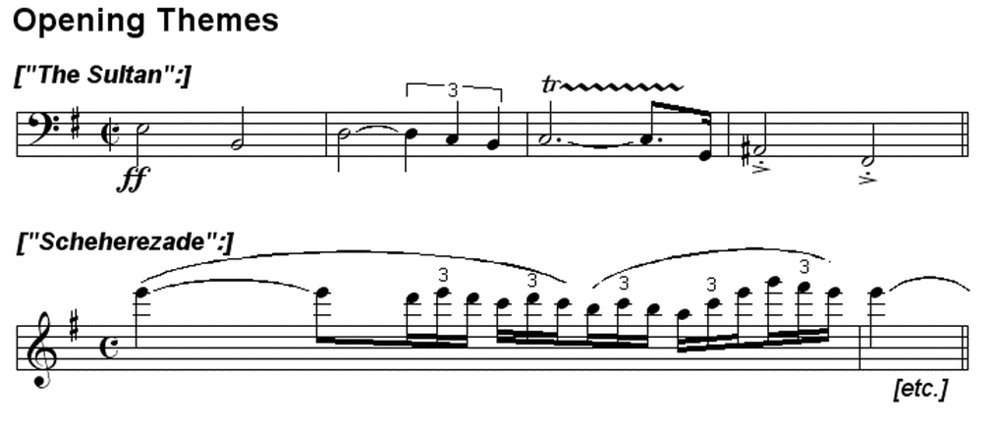
Rimsky-Korsakov opens this movement with two opposing motives: a stern and solemn tune dominated by the brass that represents the Sultan, and a sinuous violin melody that represents Scheherazade. Rimsky-Korsakov described the two themes, which wind throughout all movements of the work, as "purely musical material … Appearing as they do each time under different moods, the same motives and themes correspond each time to different images, actions, and pictures". In this movement, the motives ebb and flow over a third rocking motive of a broken chord in triplets, which represents Sinbad's ship rolling over the ocean's waves.
~~~~~~~~~~~~~~~~~~~~~~~~~~~~~~~~~~~~~~~~~~~~~~~~~~~~~~~~~~~~~~~~~~~~~~~~~~~~~~~~~~~~~~~~~~~~~~~~~~~
The Legend of the Kalendar Prince
The Kalendars were a type of wandering dervishes who turned up at Eastern courts and bazaars. In this story, a prince is tired of living his routine life in a palace and wants to go out to experience life in the exciting city. He does this by disguising himself as a mysterious old Kalendar who does magic tricks and tells someone’s fortune in exchange for some food or a gold coin.
The second movement opens with Scheherazade's voice again, but this time it is more elaborate and ornamented. Rimsky-Korsakov also used an exotic, Middle Eastern-sounding melody played in turn by both the full orchestra and different solo instruments, including bassoon, oboe, flute, and horn, which represents the Prince's travels to different lands. The movement ends with the brass playing the melody while the strings and woodwinds play faster and faster notes, which represents the whirling done by the dervishes.
~~~~~~~~~~~~~~~~~~~~~~~~~~~~~~~~~~~~~~~~~~~~~~~~~~~~~~~~~~~~~~~~~~~~~~~~~~~~~~~~~~~~~~~~~~~~~~~~~~~
The Young Prince and the Young Princess
Here is the story of Prince Ibrahim who falls in love with a portrait – a picture of the most beautiful girl he has ever seen. As hard as he tries, Prince Ibrahim cannot stop thinking about the girl in the portrait. Though he has never met her, Ibrahim is determined to find out who this girl is and sets off to find her. After a long search through all the villages in the land, he finally comes to another castle just like his own. Inside the castle walls he finds the beautiful girl in the picture – Princess Jemilah. Ibrahim tells Jimelah how much he loves her and she is impressed by how long and earnestly he has searched for her. They fall in love and marry.
Rimsky-Korsakov opens the third movement with a tender melody, which represents the Prince. This melody is answered by some quick, 'flightly' notes, which represents the Princess. These two melodies flow and weave around one another until they are heard together - like the Prince and Princess have gotten over their shyness and are now having a conversation. While Scheherazade has her say, it is with the Prince's motive that the movement comes to its gentle close.
~~~~~~~~~~~~~~~~~~~~~~~~~~~~~~~~~~~~~~~~~~~~~~~~~~~~~~~~~~~~~~~~~~~~~~~~~~~~~~~~~~~~~~~~~~~~~~~~~~~
The Festival at Baghdad/The Sea and the Shipwreck
Scheherazade shows her true genius in the final movement. Her story begins in Baghdad, which is the home of Sinbad and many other characters in One Thousand and One Nights. In this scene Sinbad returns from his voyages at sea, where a brilliant festival of light and dance is happening. As the celebration goes into the night and the dancing becomes wilder, Sinbad yearns for yet more adventure and decides to head out to uncharted waters. Unfotunately, he becomes shipwrecked after a violent storm.
Rimsky-Korsakov unites many storylines and musical motives in the conclusion of Scheherazade. The music begins with an impatient Sultan, his theme hurriedly coaxing Scheherazade to finish the story, as he can barely contain himself to hear what happens next. Scheherazade begins her story (heard in the solo violin), which suddenly bursts into a vigorous dance accented by cymbal and tambourine (The Festival in Baghdad). As the dance becomes wilder (punctuated by snare and bass drum), a brass fanfare announces a return to some of the themes representing Sinbad and The Sea. The music rises and falls with the swell of the ocean until the ship goes to pieces on a rock. With a mighty crash, the music segues into a sweeping reprise of the Sultan's theme from the first movement, which then subsides as if the Sultan finally realizes he has fallen in love with the beautiful, and clever, Scheherazade. Scheherazade's violin ends the tale on a series of harmonics over a broad, sustained chord (her last words of the story).
Activity - Tall Tales
Write your own story that would entertain the Sultan, and more importantly... keep you alive! This should be 'Scheherazade' worthy.
Scheherazade
~ Program Music