Secondary General Music Lesson Ideas
The Country & People
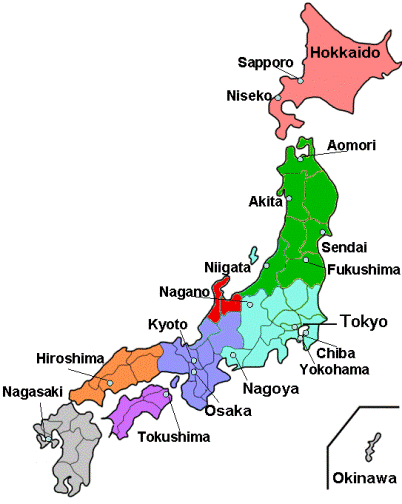
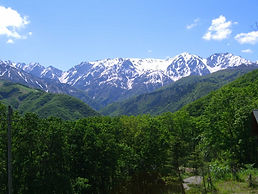
Japan is an island country located along the Pacific coast of East Asia. Made up of a group of islands, or island chain, containing 6,852 islands, Japan is split into 47 prefectures, each overseen by its own governor. Roughly 75 percent of the country is forested, mountainous, and unsuitable for agricultural, industrial, or residential use. As a result, the habitable zones, mainly located in coastal areas, have extremely high population densities. In fact, Japan is one of the most densely populated countries in the world.
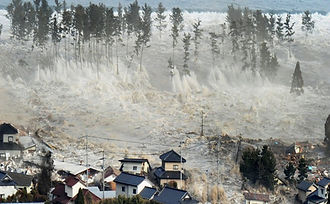
Japan has 108 active volcanoes. Due to its location in the Pacific Ring of Fire, Japan is prone to earthquakes and tsunami, having the highest natural disaster risk in the developed world.
Cherry blossoms are Japan's national flower and are known as "Sakura" in Japanese. The Sakura trees are highly esteemed. Because the season of cherry blossoms corresponds to the calendar and fiscal years in Japan, cherry blossoms are often used to symbolize hope, rebirth, and humility.
Japan is a constitutional monarchy whereby the power of the Emperor is very limited. As a ceremonial figurehead, the Emperor is defined by the constitution as "the symbol of the State and of the unity of the people." Power is held chiefly by the Prime Minister and other elected members of the government.
Japan's population is estimated at around 127.1 million, of which 98.5% are ethnic Japanese. This has created a society that is linguistically and culturally homogeneous; and, as such, Japan has traditionally rejected any need to recognize ethnic differences within the people of the country. Below are pictures of Japanese people, some wearing traditional dress known as kimonos.
~~~~~~~~~~~~~~~~~~~~~~~~~~~~~~~~~~~~~~~~~~~~~~~~~~~~~~~~~~~~~~~~~~~~~~~~~~
The Music
Japan has a long history of music making. Traditional forms, such as the gagaku or classical court music, along with traditional instruments have been around for centuries. While these art forms and instruments are still played today, other modern music forms also thrive within Japanese culture.
Traditional
The koto, introduced in the 9th and 10th centuries, is a traditional Japanese stringed
musical instrument and is considered the national instrument of Japan. Koto are almost 6 feet in length and made from kiri wood. They have 13 strings that are strung over 13 movable bridges along the width of the instrument. Players can adjust the string pitches by moving the white bridges before playing, and use three finger picks (on thumb, index finger, and middle finger) to pluck the strings, otherwise known as plectra.
Gagaku, the oldest classical music art form in Japan, was introduced with Buddhism from China in 589 (during the Sui dynasty). Considered as Japanese court music, a Gagaku ensemble consists of various wind, string and percussion instruments. Gagaku employs a version of the pentatonic scale (called a yo scale) in its music.
The shamisen is a three-stringed musical instrument introduced in the 14th century. Of varying shapes and sizes, depending on the genre in which it is used, the instrument can have a thin neck (used to accompany kabuki), or a longer and thicker neck (used to accompany puppet plays and folk songs). The shamisen is a plucked stringed instrument and its construction follows a model similar to that of a guitar.
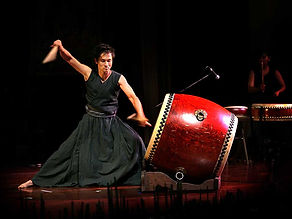
The Taiko are a broad range of Japanese percussion instruments, and the term refers to any kind of drum or the drumming ensemble itself. Taiko have a mythological origin in Japanese folklore, but historical records suggest that taiko were introduced to Japan through Korean and Chinese cultural influence as early as the 6th century. Their function has varied through history, ranging from communication, military action, theatrical accompaniment, and religious ceremony to both festival and concert performances.
Modern
J-pop, an abbreviation for Japanese pop, is a loosely defined musical genre that entered the musical mainstream of Japan in the 1990s. Modern J-pop has its roots in 1960s pop and rock music, which led bands to fuse rock with Japanese music. One of the J-pop bands that has reached America is the Japanese trio, the 5.6.7.8's, whose music is reminiscent of American surf music, rockabilly and garage rock.
Karaoke, which means "empty orchestra", is a popular social activity for Japanese adults. It is especially popular among "salarymen" or businessmen. It is common for salarymen to spend hours drinking in karaoke pubs or snack bars for hours after they get off of work. There are also Karaoke "clubs", which resemble hotels in that they have private rooms for groups of people. They are immensely popular with the people of every level of social standing. Many people fear being embarrassed by a bad karaoke performance and it is common in Japan to hire professional coaches just to improve expertise in these areas.
Karaoke was created in the early 1980s in a small Japanese town called Kobe. As the story goes, one night a guitarist was unable to make it to a gig in a local snack bar, and the owner played a recording to fill in for him. To make up for the missing guitarist, the owner encouraged the bar's guests to sing the songs with the recordings. Eventually, this evolved into the creation of karaoke kits for home use, but the poorly-insulated and tightly-spaced residences that are common in the country made home karaoke an unpopular activity. Therefore, the karaoke box came into existence in 1984 in Okayama. In karaoke boxes, people can sing as loud as they want without bothering neighbors. The karaoke phenomenon grew and grew and is now popular around the globe.
~~~~~~~~~~~~~~~~~~~~~~~~~~~~~~~~~~~~~~~~~~~~~~~~~~~~~~~~~~~~~~~~~~~~~~~~~~
Karaoke - Extension Activity
Background
Most clubs that specialize in offering karaoke in Japan are open for business around the clock. On average, it costs twelve dollars per hour for each member of a group. However, this sometimes includes all you can drink or eat deals. The rooms are stocked with everything a person needs to enjoy a night of karaoke. The equipment includes televisions, video karaoke machines, microphones, and even maracas and tambourines.
Karaoke rooms range widely in style and size. The privacy of the karaoke rooms makes the experience much different and more fun than the karaoke experiences that are offered in other countries, most of which involve getting up in front of whole bars full of strangers and singing to songs played by disc jockeys. However, the private karaoke rooms of Japan are not completely soundproof and locked down. Japan's karaoke bars have great song selection in a wide variety of genres. Although most of the songs are Japanese, Beatles tunes are also quite popular, as are newer songs from the United Kingdom and the United States. If a foreign visitor is present in a bar, it is usual for people to sing western music.
Below are some karaoke songs (however, there a lots of others that can be found on youtube - see Sing King Karaoke).
Directions
1. Ask students to choose a song.
2. Find these songs and have them ready (either through youtube or download onto a
computer/screen).
3. Set up a "private" karaoke room for 5-6 people (I use a practice room).
4. Allow students to go with their group and have a try.
5. While a small group is in the karaoke room, have the other students do one of the
following activities (see extensions 2 & 3).
Japan






"Taiko" Drumming - Extension Activity
Note: The following tutorial and study guide came from The Taiko Project (click here). This tutorial includes the history of taiko drumming, how to make 'homemade' taiko drums, and lesson activities. Great resource.
Oragami - Extension Activity
Note: These tutorials came from Origami Fun (click here for other tutorials).
Twirling Bird - easy
Crane - medium easy