Secondary General Music Lesson Ideas
Form
~ Intro - Part 1

Lesson Plan
1. When a composer starts to write a piece of music, they do not just throw a whole bunch of melodies and harmonies down on a page and
hope it works out. Instead they organize their compositions through musical ideas. The smallest type of musical idea is called a motive.
Definition: A motive is the smallest identifiable musical idea, can be either melodic and/or rhythmic, but is not a complete musical thought.
A good analogy of a motive is a sentence fragment. If you have ever written a paper using a word processing program, you know that sometimes
it underlines a sentence that it does not consider to be a complete thought or sentence (and a prompt usually pops up saying, 'fragment, consider
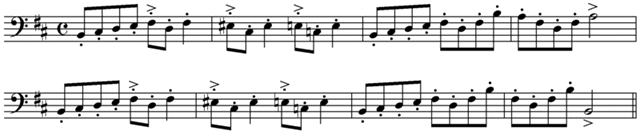
rewriting'). This is what a motive is like. It sounds okay and it sort of makes sense, but it is not complete. Here is an example of a motive that is
both melodic and rhythmic.
2. Sometimes a composer creates a motive that designates a person, place, thing or idea. This type of motive is called a leitmotif.
Definition: A leitmotif is a specific type of motive that designates a person, place, thing or idea.
Richard Wagner, a composer from the Romantic Period, was the first to use leitmotifs. Watch this video to learn more about it...
Wagner is famous for using leitmotifs in his operas; however, we can hear leitmotifs even if we do not go to the opera. Music heard in movies
and on TV often include leitmotifs to designate a person, place, thing or idea. See if you can name the movie or TV show just from the leitmotif.
3. The next sized musical idea is called a Phrase.
Definition: A Phase is built by combining motives into a complete musical thought.
If a motive is a sentence fragment, then a musical Phrase is like a complete sentence because it makes sense on its own. Below is an example of
what a Phrase sounds like in music.
All music has Phrases. These Phrases can either stand alone (because they make sense on their own) or be paired with another Phrase to create
an even larger and more complete musical thought.
4. When Phrases are combined together to complete a larger idea, this is called a Period.
Definition: A Period is when two Phrases are paired together to create a more complete musical idea. These Phrases must be adjoining, have a
musical relationship, and complete one musical thought.
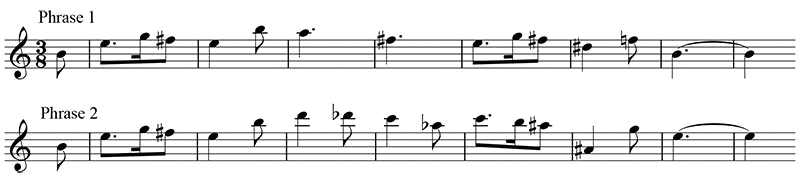
When composers pair two Phrases together, the first Phrase will sort of 'ask' a question or make a statement, while the second will 'give' an answer or response. The Phrase that asks the question or makes a statement is called an Antecedent, while the Phrase that gives the answer or response is called a Consequent. A Period is like two sentences within a paragraph that highly relate to one another and come one after the other.
Activity: Ask students to turn to a neighbor. One person in each pair will be the Antecedent and one person will be the Consequent. The
person who is the Antecedent, please ask your partner a question or make a statement. The person who is a Consequent, please
answer your partner's question or make a response to their statement. Ask students to switch roles.
Examples: Do you want to go to lunch with me? No, I've already eaten lunch.
It sure is hot outside today. Yeah, I'm sweating buckets!
It is often easier to hear the Phrases that make up a Period, rather than identifying them in a piece of music. Therefore, listen to the audio(s) below at least three times. The first time, just listen to the individual Antecedent and Consequent separately. Then, listen again, but this time listen to the complete musical Period, which combines the Antecedent and Consequent. Finally, listen to the Period while looking at the music.
Listening 1
Listening 2
Listening 3
5. While composers use Periods to make more complete thoughts within their compositions, they do not use this technique exclusively. Many times
composers will use a combination of Phrases and Periods to create their melodies. Let's listen to an example to hear what this sounds like. Try to
determine which are Phrases and which Phrases turn into Period(s). (There is a PowerPoint that I use for this listening lesson, which includes
icons and score snippets like below. Click here to access).
Phrase
Phrase
Phrase
Phrase
Antecedent
Period
Consequent