Secondary General Music Lesson Ideas
A Little History
The Classic Period refers to the time from 1750 to 1820, and falls between the Baroque and the Romantic Periods. When the term ‘classical music’ was coined, this actually meant music from the Classic Period (i.e., music composed between 1750-1820). However, today many people call all Western Art music ‘classical’. For the purposes of this discussion, classical music will denote music from the Classic Period.
There were two major movements that helped shape the music of the Classic Period: the Enlightenment and Neoclassicism. While these movements were different, they were also intertwined. Neoclassicism was an artistic manifestation of aesthetic and cultural ideals, while the Enlightenment was a wider philosophical and political movement focusing on the human condition.
The Enlightenment was an era from 1650s to 1780s in which scientists and philosophers in Western Europe emphasized reason, analysis, and individualism rather than traditional lines of authority, such as the Catholic Church and/or the monarchy. The Enlightenment philosophy embraced ways to reform society with tolerance, science and skepticism. Many upheavals and changes began because of Enlightenment ideas, such as the American
Revolutionary War and the French Revolution. Enlightenment ideas were also strongly influential in the Industrial Revolution, the Constitution of the United States, the rise of capitalism, and the wide availability of printed materials.
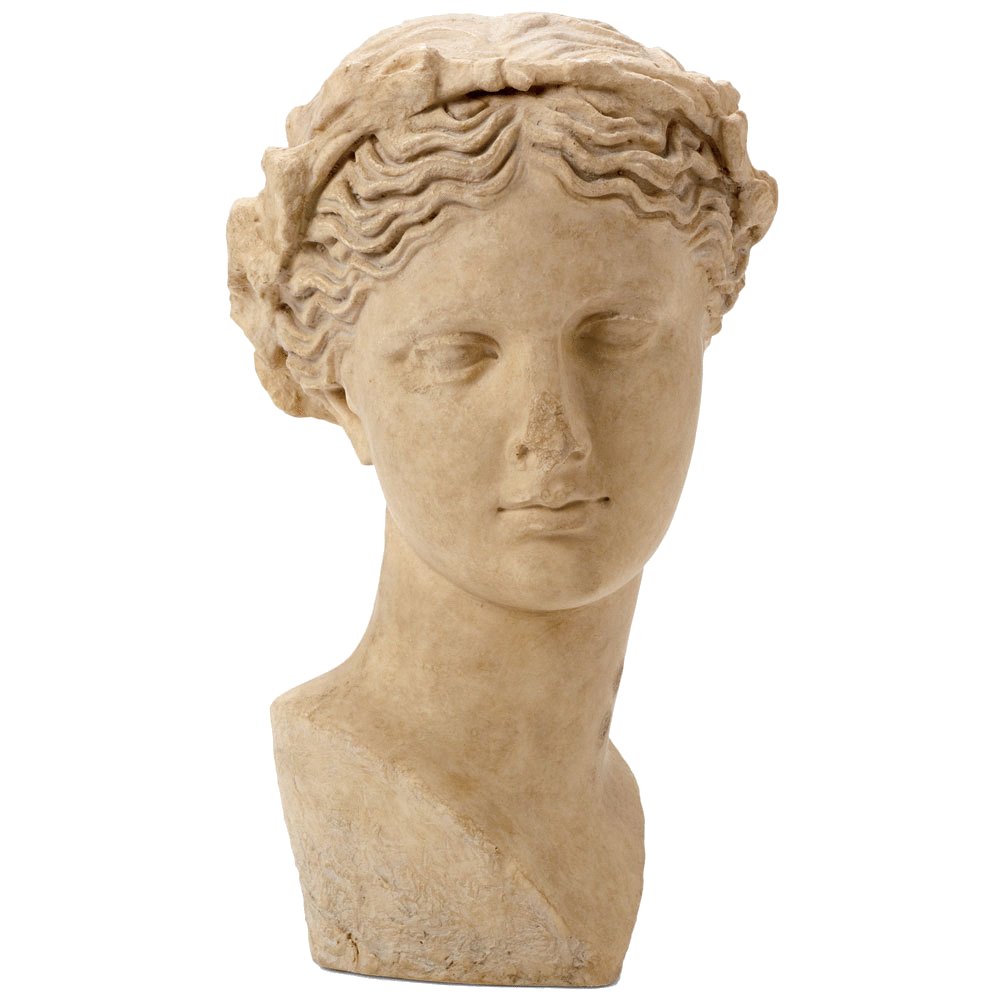
Neoclassicism was a reaction against the Rococo style of the late Baroque Period, which was all about soft, pastel colors, curving shapes, and subjects that were entertaining and sensual rather than serious. Instead, the neoclassical movement embraced the idea of natural philosophy, which stressed that structures should be well articulated and orderly. This movement first began in the middle of the 18th century when Europe started to move toward a new style in architecture, literature, and the arts that sought to emulate the ideals of classical antiquity, especially those of classical Greece.
So, what does this have to do with music from the Classic Period? Well, these movements, with their philosophies for structural clarity and rationalism, influenced Classic Period composers to move away from the layered polyphony of the Baroque period toward homophony, in which the melody is played over chordal harmony. This resulted in the melody of a piece of music becoming much more audible to the listener, and allowed composers to notate a greater variety of dynamics and phrasing within the melodic line in order to create more contrast.
The Enlightenment and Neoclassical movements also influenced composers in this period to start organizing their music into orderly forms. This resulted in standardized forms for specific types of music compositions, which are still used today. These forms include: Theme and Variation, Rondo, Sonata, Concerto, and Symphony (see the Theory pages for more information about these forms). These forms also helped to standardize the instrument families, as well as determine which instruments should play in each form.
While the Classic Period was relatively short, this time period contains two of the most recognized composers of all time, Mozart and Beethoven. Additionally, many famous people were alive during the Classic Period. Check out the time machine to put the music of the Classic Period into perspective with other historic happenings of the time (click the icon below to access the keynote presentation).
Below is a brief overview of the Classic Period by Classic FM, as well as two mini history lessons for the composers Mozart and Beethoven. To access the lessons, click on the specific composer's bust.