Secondary General Music Lesson Ideas


A Little History
The term “Baroque” has been widely used since the 19th century to describe the time period in European Classical Music from about 1600 to 1750. Baroque actually means oddly-shaped pearl in Portuguese, which was coined by 19th century critics who thought the music of this time period was overly ornamented and exaggerated. While the music of the Baroque Period may have been incredibly elaborate, this style also reflected what was going on in art and architecture at the time.
Although a single philosophy cannot describe 150 years of music from all over Europe, several concepts are important in the Baroque Period. One of the major philosophical ideas in Baroque music comes from the Renaissance interest in ancient Greece and Rome. The Greeks and Romans believed that music was a powerful tool of communication and could arouse any emotion in its listeners. As a result of the revival of these ideas, composers became increasingly aware of music’s potential power, and cultivated the belief that their own compositions could have similar effects if they correctly emulated ancient music.
In previous musical eras, a piece of music tended to consist of a single melody, perhaps with an improvised accompaniment, or several melodies played simultaneously. Not until the Baroque period did the






concept of “melody” and “harmony” truly begin to be articulated. As part of the effort to imitate ancient music, composers started focusing less on the complicated polyphony that dominated the fifteenth and sixteenth centuries and more on a single voice with a simplified accompaniment, or monophony. If music was a form of rhetoric, as the writings of the Greeks and Romans indicate, a powerful orator is necessary—and who better for the job than a vocal soloist?
Contrast is also an important ingredient in the drama of a Baroque composition. The differences between loud and soft, solo and ensemble, different instruments and timbres all play an important role in many Baroque compositions. To create this 'drama', composers began to be more precise about instrumentation, often specifying the instruments on which a piece should be played instead of allowing the performer to choose. Brilliant instruments like the trumpet and violin also grew in popularity.
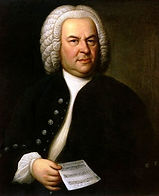
Any discussion of Baroque composers should be tempered, at least slightly, by the reality of their lives. In modern times, artists frequently earn a living producing exactly the kind of art they are moved to create. Accordingly, we often think of the artist - and the degree of his or her artistic inspiration - as the starting point for a work of art. Throughout much of the Baroque era, however, composers only earned a living writing music if they were fortunate enough to be on the payroll of a political or religious institution. The musical needs of that institution, therefore, dictated the music the composer produced. Bach wrote the number of cantatas he did, for example, not necessarily because he found the form inspirational, but because of the liturgical demands of the Leipzig church that employed him. When viewed in this light, Baroque music can provide a fascinating window into history.
In modern times, going to a concert is an event. We hear an ad on the radio or see a listing in the newspaper; we purchase tickets; we go to a concert hall and sit quietly until it is time to applaud. In the Baroque era, this kind of public concert was rare. Many of the most famous Baroque compositions were performed in churches for a service, or as part of a private concert or celebration in the home of a wealthy patron. During the course of the Baroque, however, public performances became more common, particularly in the genres of opera and oratorio, and our modern concert tradition began to coalesce in many European cities. The advent of the public concert made the growing middle class an important source of income for musicians. By the end of the Baroque period, this social subset had become a musical patron almost as powerful as the church or court.
There were many other exciting philosophies, invetions, and art that happened during the Baroque period. For example, the acceptance of Copernicus’s 16th century theory that the planets did not revolve around the earth made the universe a much larger place, while Galileo’s work helped us get better acquainted with the cosmos. Advances in technology such as the invention of the telescope made what was believed to be finite seem infinite. Geniuses like Rubens, Rembrandt and Shakespeare offered unique perspectives through their art. European nations grew more and more involved with foreign trade and colonization, bringing us into direct contact with parts of the globe that were previously unfamiliar. And the growth of a new middle class breathed life into an artistic culture long dependent on the whims of church and court. Check out the time machine to put the music of the Baroque Period into perspective with other historic happenings of the time (click the icon below to access the keynote presentation).
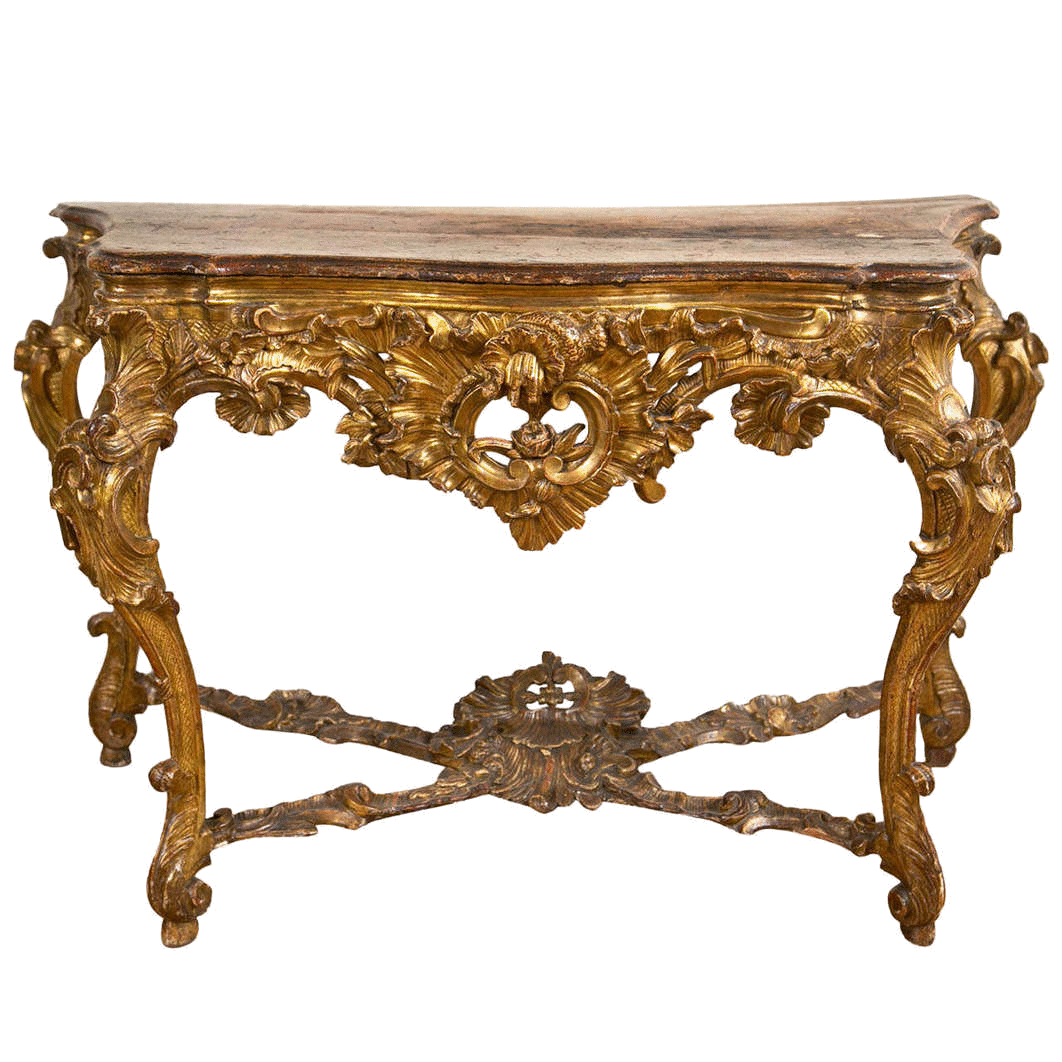
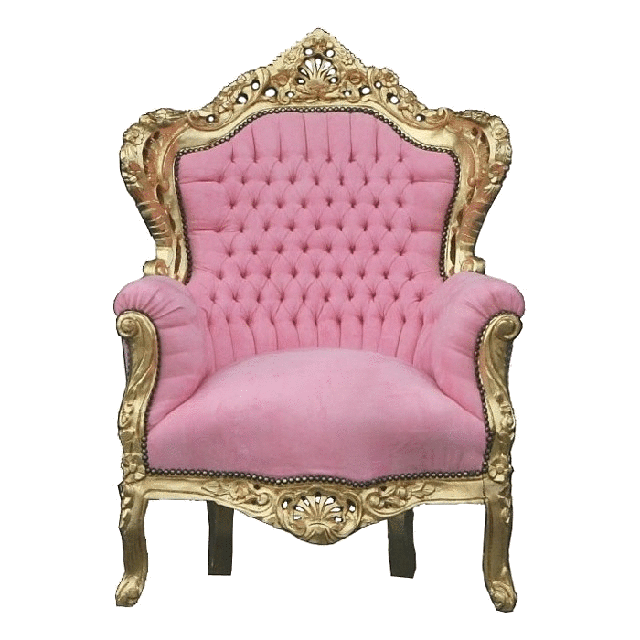
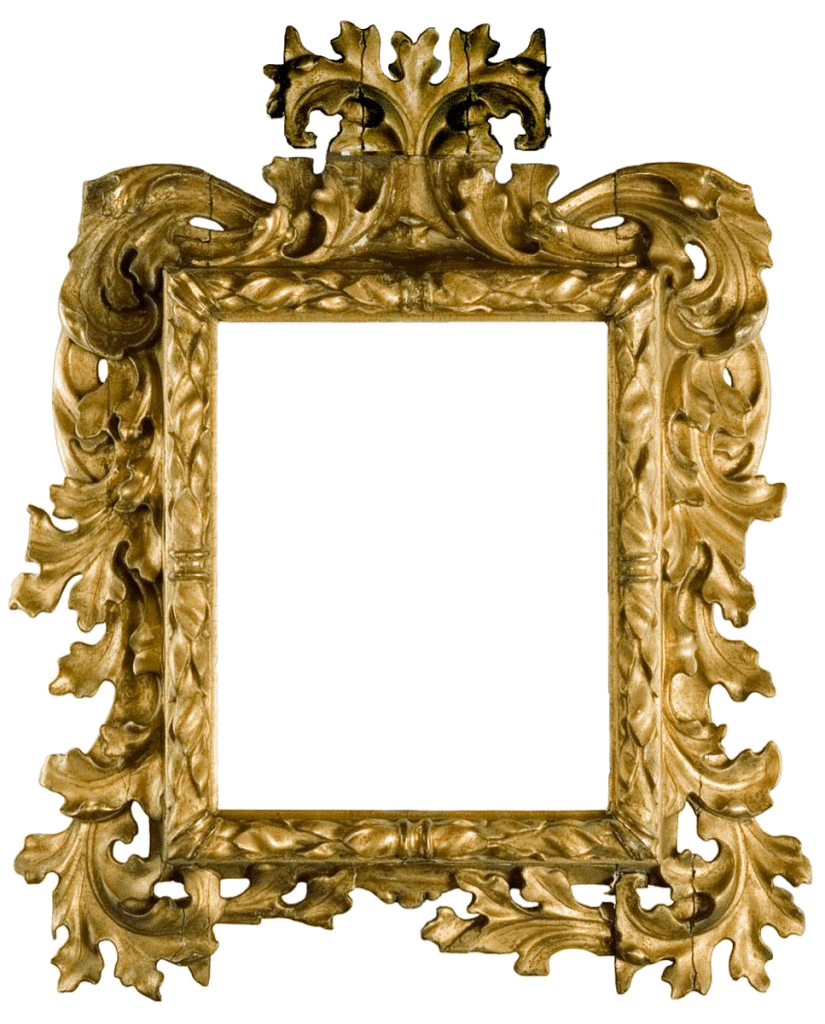
During the latter part of the Baroque Period an artistic movement and style called Rococo was formed. This style, which was ornate, used light colours, asymmetrical designs, curves, and gold, affected many aspects of the arts including painting, sculpture, architecture, interior design, decoration, literature, music, and theatre. It developed in the early 18th century in Paris, France as a reaction against the grandeur, symmetry, and strict regulations of the early Baroque, especially of the Palace of Versailles (see picture of the gardens of Versaille below). Unlike the structure of the early Baroque, the Rococo had playful, graceful and witty themes. For example, the interior decoration of Rococo rooms were designed as a total work of art with elegant and ornate furniture, small sculptures, ornamental mirrors, and tapestry complementing architecture, reliefs, and wall paintings (see picture below). In regard to Rococo music, it can be characterized as light, intimate music with extremely elaborate and refined forms of ornamentation. Take a listen...
Although the Baroque period ended over 250 years ago, traces of the era can be heard everywhere. Some of the most influential and beloved compositions are regularly performed in concert halls, and a wealth of recordings make Baroque music available on demand. Many of the musical genres still in use today, like the oratorio, concerto and opera, originated during the Baroque period. Its influence can even be heard outside the realm of art music: the free movement between solo and group in jazz is sometimes compared to Baroque music, and snippets of Bach and Handel frequently appear in tv commercials and movie soundtracks.
Below is a brief overview of the Baroque Period by Classic FM, as well as mini history lessons for the composers Bach, Handel and Vivaldi. To access the lesson, click on the specific 'portraits'.